APP DEVELOPMENT
Apps that help people finish a task.
An app is a product people return to, not a brochure. We build with React Native for mobile apps, use Flutter when that fits the brief, and use Python when the product needs AI. Web apps on React and Next.js stay available for tools that live in the browser.
WHAT'S INCLUDED
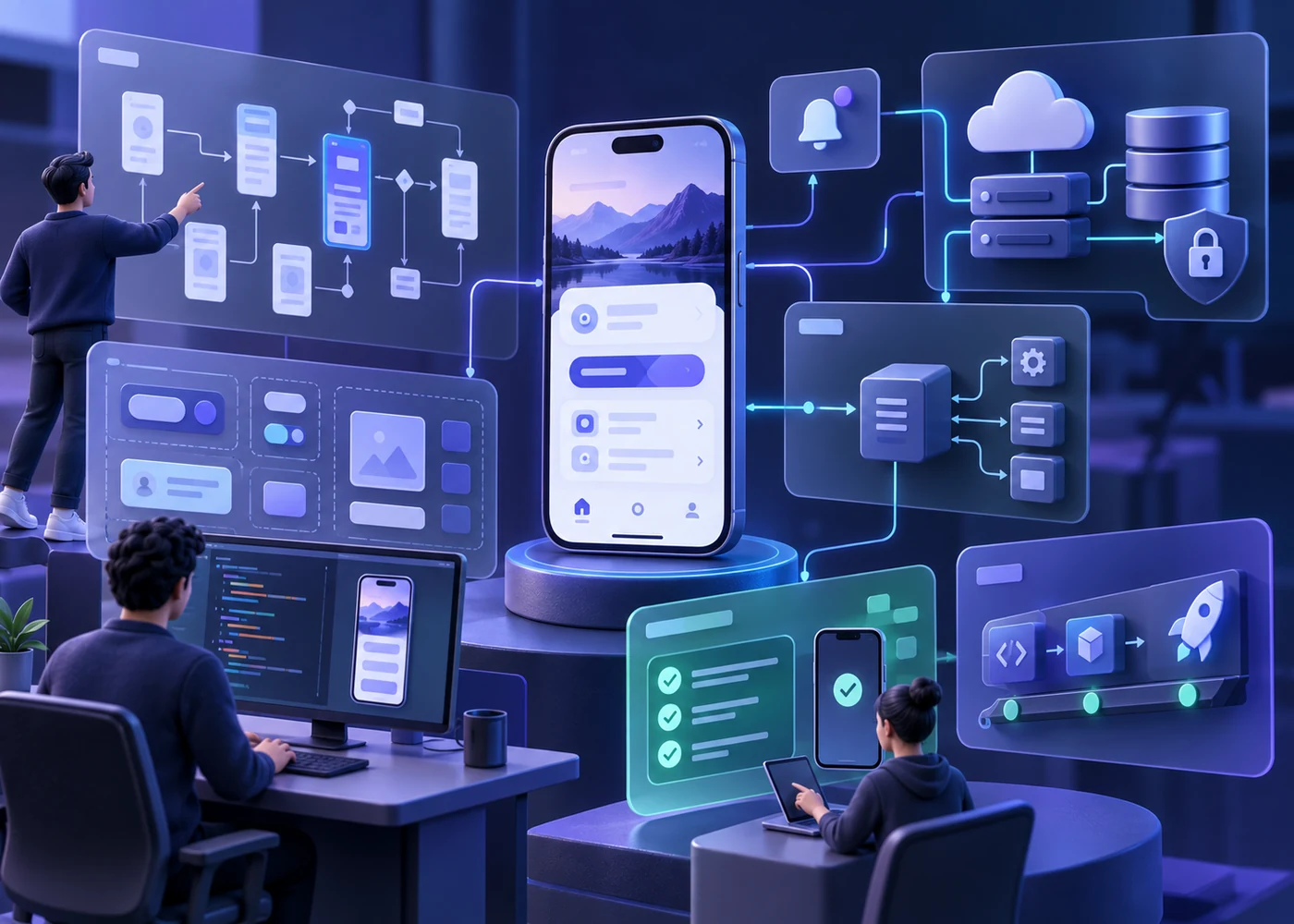
What app development covers.
Mobile and web apps on React Native, Flutter, or Python, chosen for the brief.
React Native
iOS and Android apps from one React codebase, for the mobile product the brief describes.
Flutter
Used when the requirements are a better match for Flutter than for React Native.
Python for AI
Python services for AI-related features, such as classification, assistants, or data processing behind the app.
Product screens
The main flows are mapped before build, so the app has a path through each task.
Accounts and data
Sign-in, roles, and saved records when different people should see different parts of the app.
Handover
A documented build your team or another developer can continue.
PROBLEMS WE SOLVE
Sound familiar?
These are the situations clients describe when they come to us for this work.
The work still happens in spreadsheets and email threads.
A website explains the offer, but there is nowhere to manage the actual job.
Staff and customers need different views of the same information.
An earlier app is hard to change because nobody documented how it works.
BENEFITS
What you get out of it.
A task with a screen
Each important job has a flow, instead of a pile of loose pages.
A stack that fits
React Native, Flutter, or Python is chosen for the product, not applied to every brief.
Clear permissions
People see the parts of the app their role needs.
Usable on a phone
The screens in scope are checked on small and large widths.
DELIVERABLES
Typical deliverables.
These are possible deliverables, not a bundled promise. Your proposal names the files, functionality, review rounds and handover included.
- Agreed flows for the tasks in scope
- A working app on the stack agreed in the scope
- Sign-in and roles when the brief includes them
- Forms with validation for the records the app stores
- Responsive layouts for the screens we build
- A handover note for the codebase
PROCESS
How the work runs.
Name the tasks
We list what people must be able to do, and what can wait.
Shape the flows
Screens and steps are agreed before the full interface is built.
Build in slices
Working slices go to a staging URL so you can try the task, not only look at a picture.
Hand over
The app, access, and a short guide are delivered together.
Who is this for?
Apps for accounts, bookings, dashboards, and AI-related tools, built with React Native, Flutter, or Python as the project requires.
When a smaller scope may be enough
Start with the specific problem and the assets you already have. A targeted improvement may be enough without commissioning every capability on this page.
What affects the cost?
Deliverable count, asset readiness, technical dependencies and review rounds affect the estimate. The proposal names the work and approval stages; ongoing support is scoped separately.
Discuss the project scopeWhat to bring to the brief
Bring the current assets, intended audience and requirements. Share account access by invitation where possible rather than sending passwords in the enquiry form.
Related guidance
WHY ZYFISTA
How we work on app development.
The same principles run through every engagement, whatever the service.
Strategy before execution
We establish what the site has to achieve before anyone opens a design tool. It is the cheapest stage to change your mind in.
Design that supports business goals
Every page has a job. Layout, hierarchy, and copy are judged on whether they help it do that job.
Development built for scale
Typed, documented code and content models that hold up when the site doubles in size.
SEO considered from day one
Structure, markup, and internal linking are designed in, planned early so content and engineering support each other.
RELATED WORK
App Development in practice.
Real portfolio work and clearly labelled studies that show how this capability is applied.
FAQS
Questions about app development.
Do you build iOS and Android apps?
Yes, with React Native. Flutter is used when the requirements suit it better. A web app on React and Next.js is still an option when the product should live in the browser.
Can you build AI features in Python?
Yes, when the app needs them. Python is used for AI-related work such as assistants, classification, or processing data the app depends on. The scope says what the AI feature does before it is built.
Can this sit beside our website?
Yes. The marketing site and the app can share a brand and a domain, with the app handling the signed-in work.
Who owns the code?
On final payment you receive the agreed application and its source, as set out in the proposal.
How is this different from web development?
Web development is the public site: pages, content, and enquiries. App development is the product people use to complete a repeated task.
Ready to start on app development?
Tell us what you are working with and what it has to achieve. You will get a specific proposal, not a generic package.