DESIGN
Design that moves people to act.
A good-looking site that nobody acts on is a cost, not an asset. We design around the decision you need visitors to make, then make that path the most obvious thing on the screen.
WHAT'S INCLUDED
The web design engagement.
Interfaces designed around what you need visitors to do.
Messaging and page structure
What each page says first, and in what order, before any visual design starts.
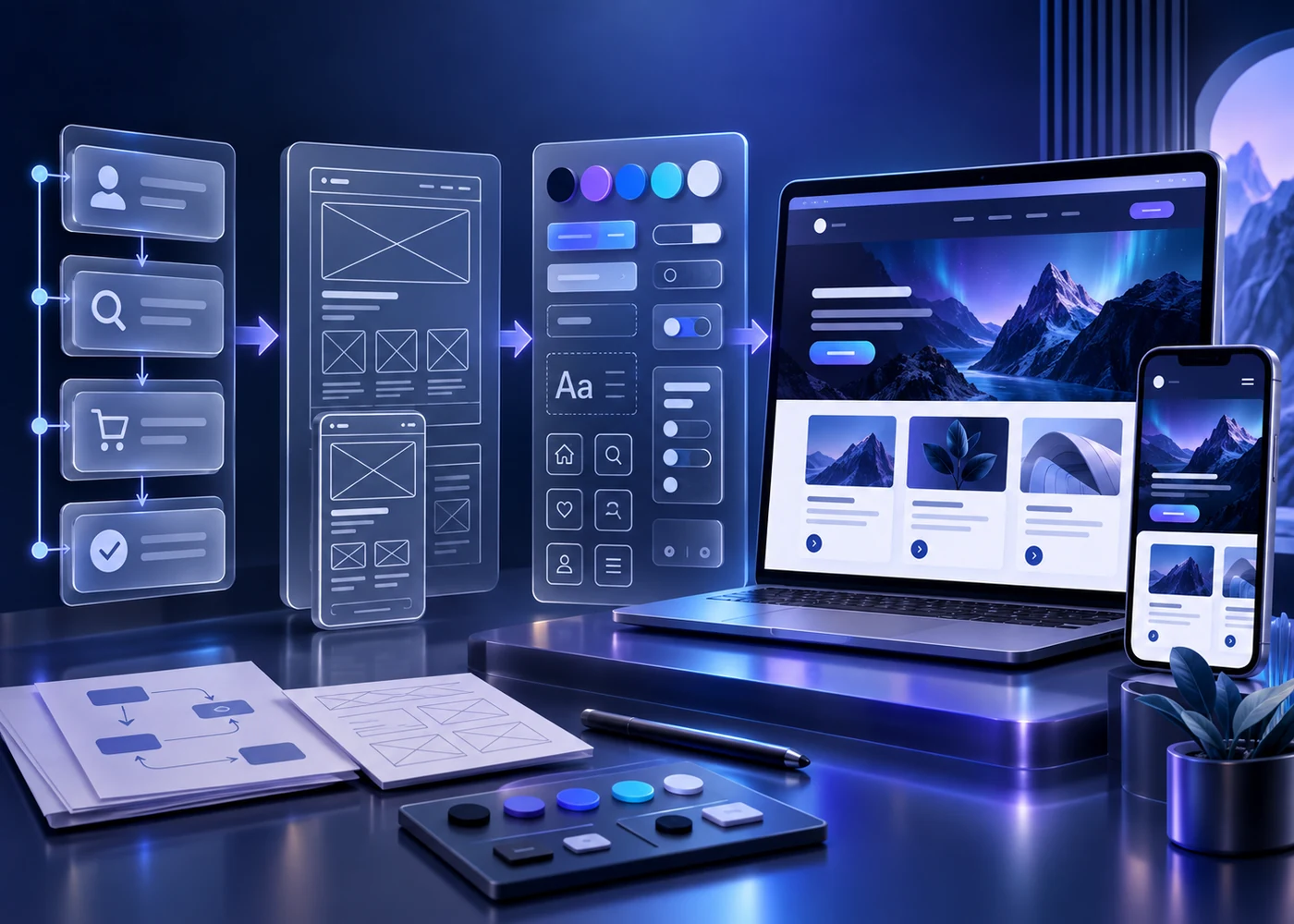
Wireframes
Layout and hierarchy agreed in greyscale so structure is settled before styling opinions arrive.
Visual design system
Type scale, colour, spacing, and component states documented rather than improvised per page.
Responsive layouts
Designed at desktop, tablet, and mobile widths, not a desktop file squeezed down later.
Interaction and motion
Hover, focus, loading, empty, and error states specified so the build has no gaps to guess at.
Developer handoff
Annotated Figma files with tokens and specs the build can follow without back-and-forth.
BENEFITS
Why it is worth doing properly.
One clear next step per page
Each page has a job, and the layout supports that job instead of competing with it.
A system, not a set of pages
Components and tokens mean new pages stay consistent without redesigning from scratch.
Designed for real content
We design with your actual copy and images, so the layout supports the information your customers actually need.
Buildable as drawn
Specs cover states and breakpoints, so the finished build matches what was approved.
PROBLEMS WE SOLVE
The things people tell us.
These are the situations clients describe when they come to us for this work.
The site looks fine but visitors never reach the enquiry form.
Every page was designed separately, so nothing feels like one product.
The mobile experience is clearly an afterthought.
Nobody can say what the homepage is actually asking the visitor to do.
DELIVERABLES
Typical deliverables.
These are possible deliverables, not a bundled promise. Your proposal names the files, functionality, review rounds and handover included.
- Page-level messaging and content structure
- Wireframes for all key templates
- Desktop, tablet, and mobile visual designs
- Documented design system with components and tokens
- Interaction and state specifications
- Annotated developer handoff files
PROCESS
How the work runs.
Understand the decision
We establish who visits, what they need to know, and what action defines success for the page.
Structure first
Hierarchy and messaging are agreed in wireframes so the visual stage is not solving structural problems.
Design the system
One or two key templates are designed to a finished standard, then the system is extended across the rest.
Prepare for build
States, breakpoints, and tokens are documented and walked through with the developers.
Who is this for?
Design that earns attention and then directs it, clear hierarchy, honest messaging, and layouts built for the decision you want.
When a smaller scope may be enough
Start with the specific problem and the assets you already have. A targeted improvement may be enough without commissioning every capability on this page.
What affects the cost?
Deliverable count, asset readiness, technical dependencies and review rounds affect the estimate. The proposal names the work and approval stages; ongoing support is scoped separately.
Discuss the project scopeWhat to bring to the brief
Bring the current assets, intended audience and requirements. Share account access by invitation where possible rather than sending passwords in the enquiry form.
Related guidance
WHY ZYFISTA
How we work on web design.
The same principles run through every engagement, whatever the service.
Development built for scale
Typed, documented code and content models that hold up when the site doubles in size.
SEO considered from day one
Structure, markup, and internal linking are designed in, planned early so content and engineering support each other.
Clear project communication
A staging URL you can check any time, weekly written updates, and early warning when something slips.
Long-term growth mindset
We would rather build something you can extend for years than something that needs replacing in eighteen months.
RELATED WORK
Web Design in practice.
Real portfolio work and clearly labelled studies that show how this capability is applied.
FAQS
Questions about web design.
Do you design in Figma?
Yes. You get access to the working file, the component library, and the tokens, not a flattened export.
Can you work with our existing brand?
Yes. If you have guidelines we design inside them. If they are thin, we will flag the gaps and can extend the system as part of the work.
How many revision rounds are included?
Two structured rounds per stage, which is normally enough because structure is agreed before visual design begins. Additional rounds are quoted transparently.
Do you also build what you design?
Usually, and it removes a whole class of handover problems. We are also happy to hand off to your in-house or third-party developers.
Ready to start on web design?
Tell us what you are working with and what it has to achieve. You will get a specific proposal, not a generic package.