GAMING LOUNGE MANAGEMENT PLATFORM
OGz Gaming Arena
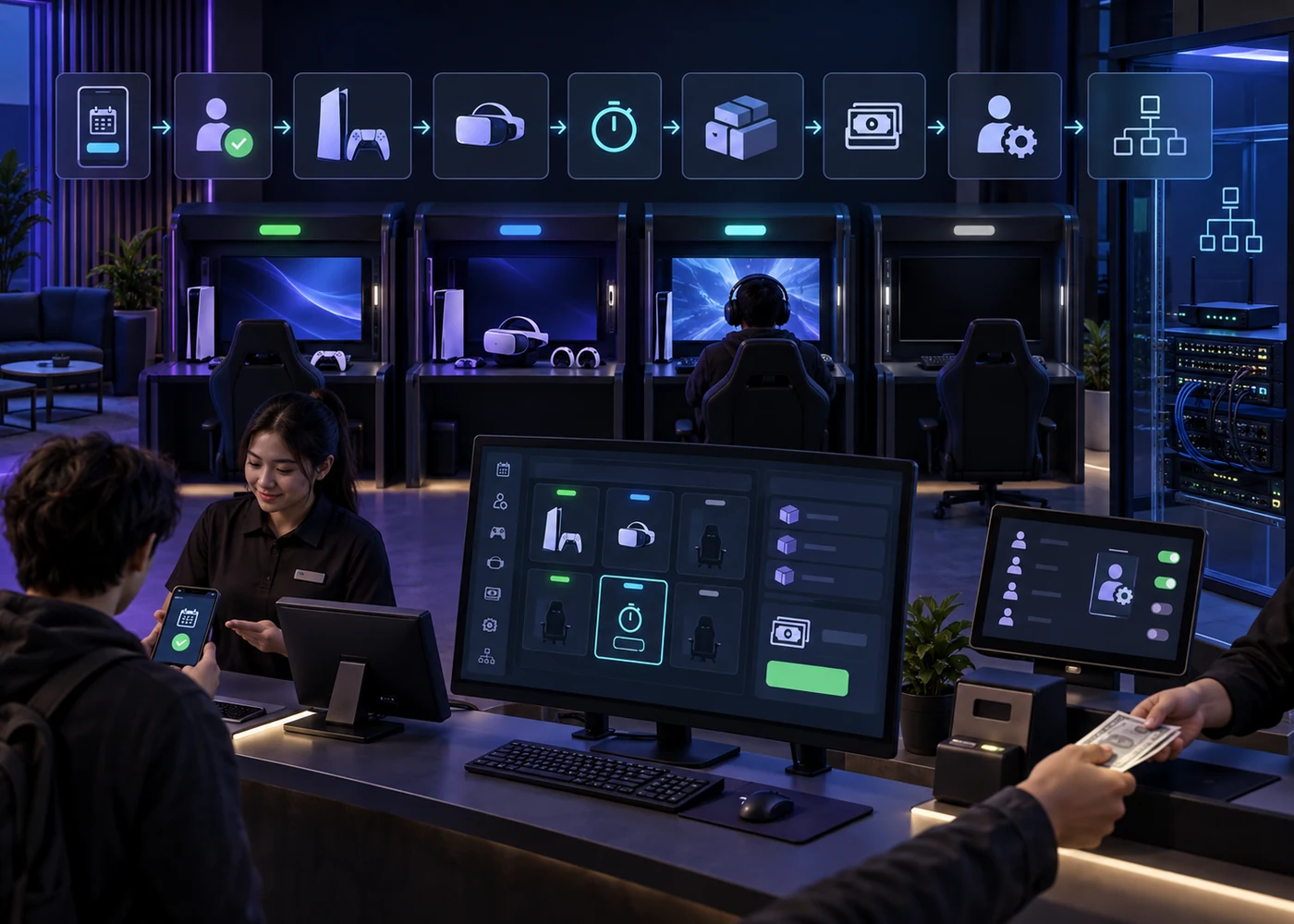
A local-first platform connecting reservations, walk-ins, PS5 and VR stations, live sessions, package billing, payments, and staff operations.
Project details
- Project type
- Gaming lounge operations
- Services
- Web Development
- Web Design
- Industry
- Gaming & Entertainment
- Project status
- Active development
Development by Ghulam Hussain for OGz Gaming Arena. Selected team work; the source portfolio identifies this project as active development in 2026.
OVERVIEW
The situation.
OGz Gaming Arena brings a public lounge website and booking experience together with a protected operations console. Owners and staff manage customers, reservations, stations, session timing, bills, cash payments, reports, and business settings from a system designed for the lounge’s local network.
THE CHALLENGE
What was getting in the way.
The constraints that shaped every decision that followed.
- Coordinate reservations and walk-ins with station availability.
- Keep session timing, package prices, invoices, and payments consistent.
- Separate owner and staff permissions across sensitive operations.
- Support lounge-local operation when internet connectivity is unreliable.
APPROACH
The implementation approach.
Separate the journeys
A unified Next.js application provides public booking and authenticated tools for owners and staff.
Model the session lifecycle
Session and billing services connect station state, elapsed time, invoices, and payment records.
Protect operational changes
Signed-cookie checks, role permissions, validated inputs, and transactional database operations govern access and changes.
Package for local operation
Docker runs the application and PostgreSQL together. An offline sync queue supports later reconciliation when connectivity returns.
SOLUTION
What was built.
- Customer records, reservations, and walk-in workflows.
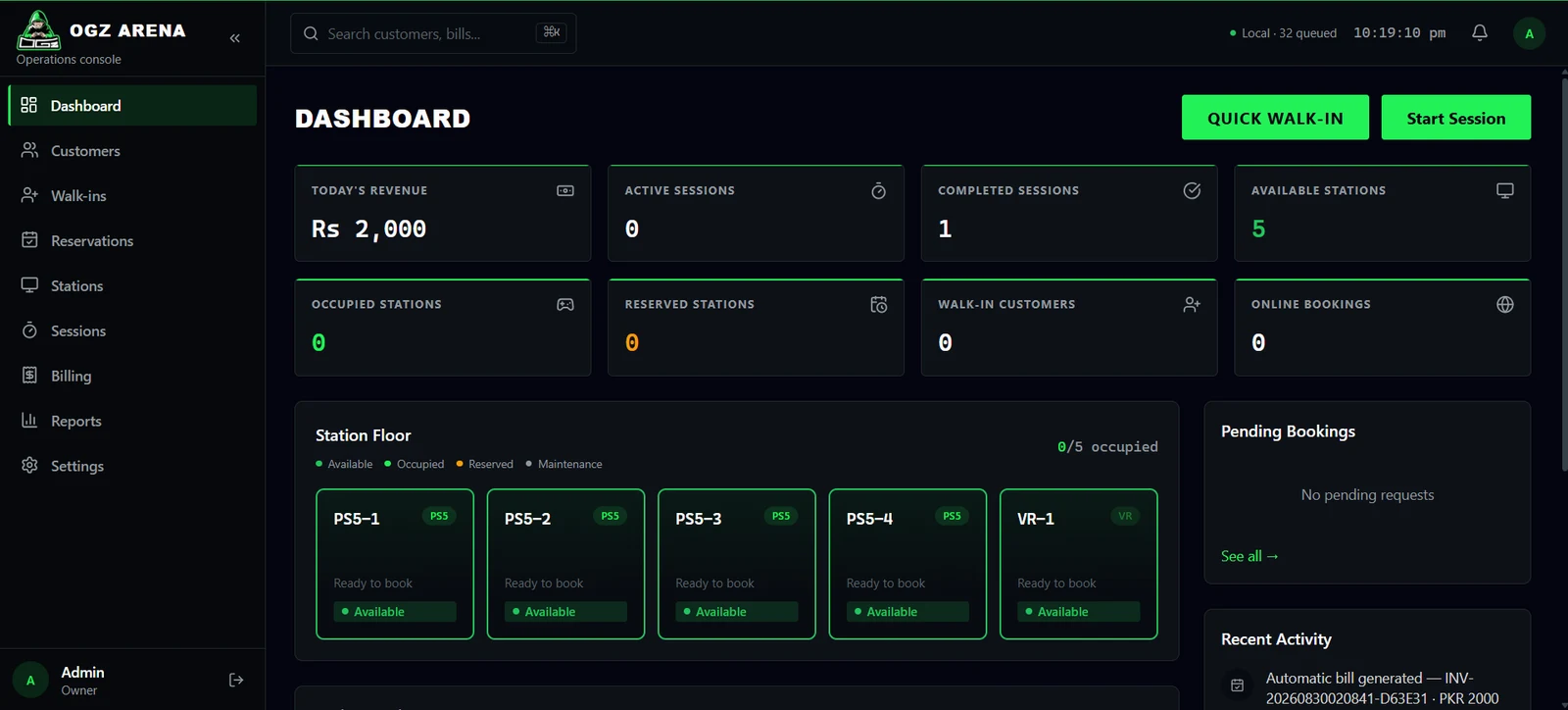
- PS5 and VR station configuration and live session timing.
- Package-aware bill generation and cash payment recording.
- Reports, user management, settings, and configurable staff permissions.
DESIGN SYSTEM
The visual foundation.
The visual direction and interface choices reflected in the published project.
- Interface
- Responsive dark operations UI
- Brand
- Neon OGz styling across public and admin experiences
- Navigation
- Public booking and protected operations journeys
- States
- Station availability, live sessions, and payment status
TECHNICAL IMPLEMENTATION
How it is engineered.
Application
Next.js 16, React 19, TypeScript, and Zod support the App Router, versioned APIs, and validated domain inputs.
Data
PostgreSQL and Prisma provide relational storage and transactions for sessions, invoices, payments, and users.
Operations
TanStack Query manages client requests and mutations; Docker Compose packages the application and database for the lounge network.
FINAL RESULT
What changes.
- Centralized booking, station, session, billing, payment, and reporting workflows.
- Provided role-aware owner and staff operations with protected administrative routes.
- The source case study documents a database-backed customer-to-paid-bill smoke flow and local-network checks.
- Physical WAN-disconnect acceptance remains in progress, as stated in the source case study.
SCREENS
The work, in view.
Project imagery from Ghulam Hussain's portfolio. Portrait and detail frames show crops of the same source screenshot.
TECHNOLOGIES
Built with.
Chosen for this brief rather than applied to every project by default.
- Next.js
- React
- TypeScript
- PostgreSQL
- Prisma
- TanStack Query
- Docker
- Tailwind CSS
- Zod
Related services
Why local operation mattered
The lounge needs station, session and billing records available to its operations team. The documented architecture keeps the application and database on the lounge network.
Owner and staff browsers
Protected operations for reservations, stations and active sessions.
Next.js application
Role checks, validated inputs, session services and billing workflows.
PostgreSQL and Prisma
Related session, invoice and payment records with transactional operations.
Session-to-payment workflow
Reservations and walk-ins connect to station availability. A session records timing; the billing service applies the package and generates a bill; cash payment records complete the documented flow. Owner and staff permissions govern operational changes.
The source reports a database-backed smoke flow and local-network checks. Physical WAN-disconnect acceptance is still in progress. Public bookings, external integrations and later synchronization have different connectivity needs, so local architecture alone is not proof that every outage scenario works.
Discuss an operational web applicationWhat we learned
Station availability, session timing and payment status belong to one operational journey. The documented OGz design connects those records through session and billing services rather than treating a timer display as the whole system. Its acceptance boundary matters: a database-backed smoke flow demonstrates a workflow, while a physical outage test is a separate check.
Decisions and trade-offs
The documented architecture places the application and PostgreSQL on the lounge network through Docker Compose. This reduces dependence on an external connection for local operations, but creates responsibilities for the local host, backups and reconciliation. Public bookings and external services still have connectivity dependencies. The case study does not claim completed physical outage acceptance.
Case-study commentary updated 28 September 2026. Based on the supplied project record and assets.
Questions about this project
How does OGz connect play sessions with billing?
The documented platform connects station state and elapsed time with package-aware bills, invoices and cash-payment records. This is broader than displaying a countdown. The source case study reports a database-backed customer-to-paid-bill smoke flow; it does not provide independently verified revenue or billing-accuracy metrics.
Can OGz keep operating without internet?
OGz is designed for lounge-local operation with a Docker-packaged application and PostgreSQL database, plus a sync queue. Local-network checks are documented, but physical WAN-disconnect acceptance remains in progress. That distinction means the architecture can be discussed without claiming that every workflow has passed an outage test.
Why do station operations need role permissions?
OGz separates public booking from protected owner and staff operations. Its documented role permissions cover sensitive actions such as user management and settings alongside session and payment workflows. This illustrates why operational access needs explicit rules; it is not a claim that this portfolio review constitutes a new security audit.
START SOMETHING
Got a project that needs this kind of thinking?
Tell us what you are trying to fix or build. We will come back with a scope, a timeline, and a straight answer on whether we are the right studio for it.